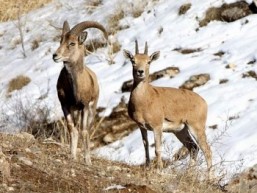
Dena

Dena

The Dena Protected Area, spanning 93,660 hectares across the Kohgiluyeh and Boyer-Ahmad and Isfahan provinces, stands as a testament to Iran’s biological richness. Established in 1990 to preserve its intact nature, this mountainous sanctuary is a land of permanent glaciers, high-flow rivers, and dramatic altitude shifts ranging from 1,360 to 4,413 meters.

Climate and Geography

Dena’s unique geography creates a diverse climatic profile. With a mean annual precipitation of 650 mm and an average temperature of 14°C, the region experiences cold sub-humid to humid climates. Visitors should prepare for:

  • Permanent Glaciers: High-altitude ice fields that feed the region’s rivers.

  • Prolonged Frost: Long winter periods at the summits, perfect for alpine study.

  • Contrast Landscapes: A dry, grassland-dominated eastern half versus a lush, forested western half.

Flora and Vegetation

Dena is a botanical paradise, home to over 440 identified plant species. It is notably one of the few natural sites for the Plane Tree in Iran.

  • Dominant Forest Trees: Oak, Manna tree, Turk Terebinth Pistachio, and Montpellier Maple.

  • Fruit & Wild Trees: Wild Pear, Juniper, Mazzard Cherry, and Almond.

  • Herbs & Flowers: Thyme, Giant Fennel, Crown Imperial Fritillary, and Astragalus.

Rare Wildlife and Fauna

The high biodiversity of the Dena region makes it a critical hub for rare and endangered animal species in the Zagros range.

  • Mammals: The Persian Squirrel, Brown Bear, Leopard, Eurasian Lynx, and Wild Sheep.

  • Birds of Prey: Golden Eagle, Bonelli’s Eagle, Bearded Vulture (Lammergeier), and various Buzzards.

  • Specialty Species: The Caspian Snowcock and the elusive Persian Horned Viper.

Tourism and Research Opportunities

Thanks to relatively accessible roads and breathtaking scenery, Dena is a premier destination for:

  1. Athletic Activities: Professional mountain climbing and alpine trekking.

  2. Ecotourism: Wildlife photography and birdwatching.

  3. Scientific Research: Extensive studies on sub-humid ecosystems and Persian forestry.

Khangormaz

Khangormaz (also spelled Khan Garmz or Khan-Gormaz) is a prominent protected area and mountain massif in the Hamedan Province of western Iran. It is widely

Read More »

Siah kuh

Siah Kuh (Persian: سیاه کوه), meaning “Black Mountain,” refers to several locations in Iran, but the most prominent is the Siah Kuh National Park. Located
Read More »

Lashgardar

The Lashgardar Protected Area, established in 1990, stands as one of the most ecologically significant regions in Western Iran. Spanning 16,089 hectares within the Hamedan
Read More »

Bashgol

The Bashgol Protected Area is one of Iran’s most diverse ecological landscapes. Established in 1996, this 25,344-hectare sanctuary is a transition zone where rolling plains

Read More »

Contact Us

Discover the thrill of Big Game Safaris and Wild Boar hunting in Iran! Our expert guides and trackers will lead you to the best-kept hunting grounds. Join us for an unforgettable adventure!
 
© All Rights Reserved. 2025

Address